

Field Programmable Gate Array Market Size to Worth USD 27.51 billion by 2034 | CAGR of 10.2% during 2026-2034
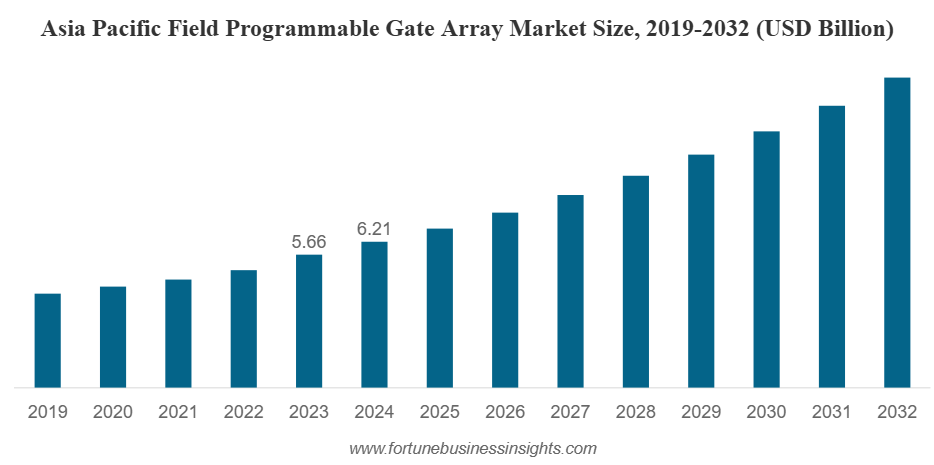
Field Programmable Gate Array Market Size
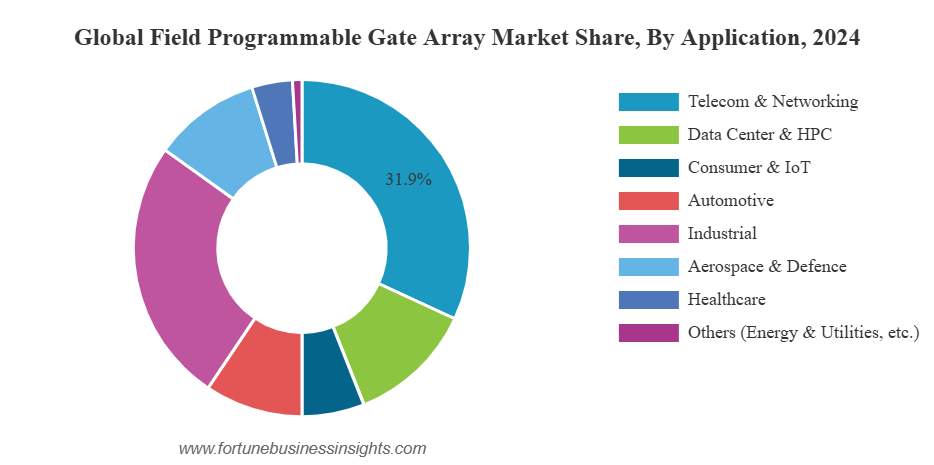
Field Programmable Gate Array Market Share
Global field programmable gate array market poised to grow from USD 12.72 billion in 2025 to USD 27.51 billion by 2034 at a CAGR of 10.2%
NEW YORK, NY, UNITED STATES, February 8, 2026 /EINPresswire.com/ -- Global Market OverviewThe global field programmable gate array market size was valued at USD 12.72 billion in 2024. The market is projected to grow from USD 13.92 billion in 2025 to USD 27.51 billion by 2032, exhibiting a CAGR of 10.2% during the forecast period. Asia Pacific dominated the field programmable gate array market with a market share of 48.82% in 2024. The Field Programmable Gate Array (FPGA) Market comprises semiconductor devices that can be programmed and reprogrammed after manufacturing to perform specific logic functions. FPGAs are widely used across industries such as telecommunications, data centers, automotive, aerospace & defense, consumer electronics, and industrial automation. Their flexibility, parallel processing capability, and low latency make them essential for applications requiring high performance, real-time processing, and rapid prototyping.
Get a Free Sample of this Report: https://www.fortunebusinessinsights.com/enquiry/request-sample-pdf/field-programmable-gate-array-market-104798
Key Market Insights
The FPGA market is witnessing strong demand from telecom infrastructure, data centers, and automotive electronics, where high-speed processing and low-latency performance are critical. Increasing adoption of FPGAs in artificial intelligence, machine learning, and edge computing workloads is further accelerating market growth, as these applications require flexible and energy-efficient acceleration solutions. SRAM-based FPGAs continue to dominate the market due to their superior performance, reprogrammability, and ability to support frequent design updates. In addition, there is a growing preference for FPGA–SoC and heterogeneous computing platforms that combine programmable logic with processors, enabling higher integration and improved system efficiency. These trends are positioning FPGAs as a key enabling technology across next-generation computing, communication, and automotive applications, supporting scalable and high-performance digital transformation initiatives.
Market Trends
The FPGA market is evolving rapidly with the rising use of FPGA accelerators in data centers to improve processing speed, reduce latency, and optimize energy efficiency for compute-intensive workloads. Integration of AI engines, digital signal processing blocks, and CPU cores within FPGA architectures is enabling highly flexible and powerful heterogeneous computing solutions. There is also growing adoption of low-power and edge-optimized FPGAs, driven by expanding applications in IoT, autonomous systems, and real-time edge analytics. Additionally, increased use of open-source development tools and platforms is lowering design complexity and development costs, making FPGA adoption more accessible to a broader range of developers. Together, these trends are expanding FPGA use cases across cloud, edge, and embedded environments, supporting scalable and high-performance computing architectures.
Market Growth Factors
The FPGA market is being driven by the rapid expansion of 5G infrastructure and high-speed networking, which require flexible, low-latency, and high-throughput processing solutions. Rising demand for hardware acceleration in artificial intelligence and data-intensive applications is further strengthening FPGA adoption, as these devices offer customizable performance and energy efficiency. Growth in autonomous vehicles, advanced driver-assistance systems, and sophisticated automotive electronics is also creating strong demand for FPGAs to support real-time processing and safety-critical functions. In addition, the need for faster time-to-market and greater design flexibility is encouraging manufacturers to adopt reprogrammable FPGA platforms that can be updated post-deployment. Together, these factors are positioning FPGAs as a critical technology for next-generation communications, computing, and automotive innovation.
Segmentation Analysis
By Architecture:
• SRAM-Based FPGA
• Flash-Based FPGA
• Antifuse-Based FPGA
By Node Size:
• ≤16 nm
• 16–28 nm
• ≥28 nm
By Application:
• Telecommunications
• Data Centers
• Automotive
• Industrial
• Aerospace & Defense
• Consumer Electronics
By End User:
• OEMs
• Cloud Service Providers
• Research & Academic Institutions
Speak to Analyst: https://www.fortunebusinessinsights.com/enquiry/speak-to-analyst/field-programmable-gate-array-market-104798?utm_medium=pie
Regional Analysis
North America dominates the FPGA market, supported by the strong presence of leading FPGA vendors, advanced hyperscale data centers, and sustained demand from defense and aerospace applications. Europe is witnessing steady growth, driven by increasing adoption of FPGAs in automotive electronics, industrial automation, and aerospace manufacturing, where reliability and real-time processing are critical. Asia Pacific represents the fastest-growing region, fueled by large-scale semiconductor manufacturing, rapid 5G network rollout, and high-volume consumer electronics production. Latin America is experiencing gradual FPGA adoption across industrial automation and telecom infrastructure projects as digital transformation progresses. Meanwhile, the Middle East & Africa region shows emerging demand, supported by investments in defense systems, expanding telecom networks, and growing smart city initiatives that require flexible and high-performance computing solutions.
Key Industry Players
• Advanced Micro Devices, Inc. (U.S.)
• NVidia Corporation (U.S.)
• Achronix Semiconductor Corporation (U.S.)
• Intel Corporation (U.S.)
• Lattice Semiconductor (U.S.)
• QuickLogic Corporation (U.S.)
• GOWIN Semiconductor (China)
• Broadcom Inc. (U.S.)
• Synopsys, Inc. (U.S.)
• Xilinx, Inc. (U.S.)
• Microchip Technology (U.S.)
• Altera Corporation (U.S.)
Key Industry Developments
• October 2025- Lattice Semiconductor, the low power programmable leader, introduced the Lattice MachXO5™-NX TDQ family, the industry’s first secure control FPGAs with full Commercial National Security Algorithm (CNSA) 2.0-compliant post-quantum cryptography (PQC) support. Built on the award-winning Lattice Nexus™ platform, MachXO5-NX TDQ FPGAs deliver unmatched security, reliability, and flexibility for Computing, Communications, Industrial, and Automotive applications as the threat of quantum-enabled cyberattacks rises.
• May 2025- Microchip Technology released PolarFire® Core Field-Programmable Gate Arrays (FPGAs) and System on Chips (SoCs). The new devices are a derivative of the base PolarFire families and reduce customer costs by up to 30 percent by optimizing features and removing integrated transceivers.
Future Outlook
The FPGA Market is expected to experience strong growth, supported by rising demand for high-performance, flexible, and energy-efficient computing solutions across multiple industries. Increasing adoption of FPGAs in data centers for hardware acceleration, along with expanding AI and machine learning workloads, is significantly boosting market momentum. Rapid deployment of 5G infrastructure and high-speed networking is further driving demand for programmable logic devices capable of low-latency and high-throughput processing. Growth in autonomous systems, advanced driver-assistance technologies, and edge computing applications is also strengthening FPGA adoption. Their reprogrammability and faster time-to-market advantages make FPGAs essential for next-generation computing architectures and real-time processing requirements.
Read Related Insights:
Subscription E-commerce Market
Bioinformatics Market
Ashwin Arora
Fortune Business Insights™ Pvt. Ltd.
+1 833-909-2966
email us here
Legal Disclaimer:
EIN Presswire provides this news content "as is" without warranty of any kind. We do not accept any responsibility or liability for the accuracy, content, images, videos, licenses, completeness, legality, or reliability of the information contained in this article. If you have any complaints or copyright issues related to this article, kindly contact the author above.
