

Smart Container Market to Reach USD 10.46 Billion by 2034 as IoT Transforms Global Logistics
Smart Container Market
The market is growing from USD 5.57 billion in 2025 as companies adopt connected containers to boost tracking, efficiency, and supply chain transparency.
Strong manufacturing growth, smart port developments, and wider IoT integration across logistics networks are accelerating adoption, with Asia Pacific leading the market.”
PUNE, MAHARASHTRA, INDIA, February 8, 2026 /EINPresswire.com/ -- The global smart container market is expanding steadily as logistics companies adopt connected technologies to improve supply chain visibility and operational efficiency. The market was valued at USD 5.57 billion in 2025 and is projected to grow from USD 5.97 billion in 2026 to USD 10.46 billion by 2034, registering a CAGR of 7.25% during the forecast period. Asia Pacific dominated the market in 2025, accounting for a 50.72% share, supported by rapid manufacturing growth, smart port initiatives, and rising IoT adoption across logistics networks.— Fortune Business Insights
Smart containers combine traditional shipping containers with integrated IoT sensors, GPS tracking, and telematics systems. These technologies enable real-time monitoring of location, temperature, humidity, shock, and door status throughout the logistics chain. Deployed across maritime, rail, and road freight, smart containers enhance cargo visibility, improve asset utilization, and reduce losses from theft or spoilage.
Get Free Sample PDF Here: https://www.fortunebusinessinsights.com/enquiry/request-sample-pdf/smart-container-market-110445
Market Drivers
Rising Demand for End-to-End Supply Chain Visibility
The global shift toward real-time logistics visibility is a primary driver of the smart container market. Businesses increasingly require continuous cargo monitoring to track location, temperature, and security across complex multimodal routes. By embedding IoT sensors, GPS, and telematics, smart containers help reduce cargo losses, prevent spoilage, and enhance asset utilization.
Market Restraints
High Connectivity and Energy Costs
Despite their operational benefits, widespread deployment of smart containers is constrained by high connectivity and energy costs. Transoceanic journeys often require satellite IoT communication, which is more expensive than terrestrial networks. This increases operational expenses for carriers managing large fleets.
Market Opportunities
Emerging Regulatory Traceability Standards
Increasing regulatory emphasis on cargo traceability presents strong growth opportunities for smart container solutions. Governments worldwide are introducing requirements for digital cargo visibility, tamper-proof documentation, and real-time monitoring of perishable or high-value shipments.
Smart containers equipped with blockchain-ready IoT sensors and geofencing capabilities can provide verified chain-of-custody data, ensuring faster customs clearance and reduced fraud risk. Vendors that align their technologies with evolving trade regulations are likely to secure long-term contracts with governments and logistics providers.
Market Trends
Integration of AI and Predictive Analytics
A major trend in the smart container market is the integration of artificial intelligence and predictive analytics into container management systems. By analyzing real-time sensor data, AI models can forecast maintenance needs, detect anomalies, and optimize routes based on traffic or weather conditions.
Market Challenges
Rising Cybersecurity Threats
As logistics systems become more connected, smart containers are increasingly exposed to cybersecurity risks. Containers communicate with shipboard networks, ports, and cloud systems, making them potential targets for data breaches, GPS spoofing, and malicious firmware attacks.
Segmentation Analysis
By Container Type
The market is segmented into dry containers, refrigerated containers, tank containers, and special-purpose containers.
The dry containers segment is projected to dominate, accounting for 46.39% of the market in 2026, due to its widespread use for non-temperature-sensitive goods such as electronics, garments, and consumer products. Retrofit programs further strengthen this segment, as upgrading existing dry containers with sensors is more cost-effective than replacing entire fleets.
The refrigerated containers segment is expected to grow at the fastest rate, driven by increasing cold-chain demand for perishable foods, vaccines, and biologics.
By Component Type
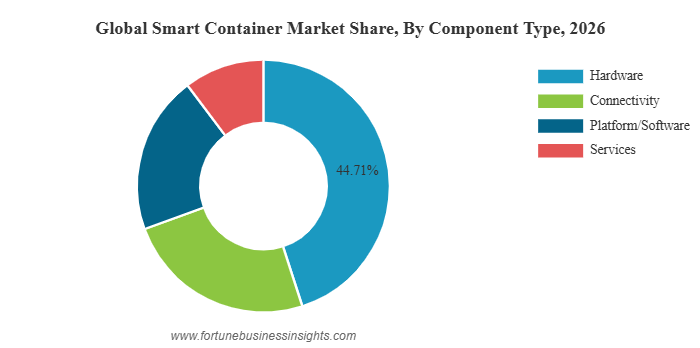
The market includes hardware, connectivity, platform/software, and services.
The hardware segment is expected to lead with 44.71% share in 2026, as sensors, GPS modules, and embedded controllers form the core infrastructure of smart container systems. Meanwhile, the platform/software segment is projected to grow at the fastest rate due to rising demand for analytics, predictive maintenance, and real-time dashboards.
By End-user
Key end users include shipping lines, freight forwarders, shippers, port operators, rail operators, and leasing companies.
The shipping lines/ocean carriers segment is expected to dominate with 31.99% share in 2026, as these companies own large container fleets and benefit from improved utilization, theft prevention, and enhanced customer transparency.
By Application
The market spans food and beverage logistics, pharmaceuticals, electronics, automotive components, chemicals, retail, and industrial goods.
The food and beverage segment leads the market due to high volumes of perishable goods requiring temperature and humidity monitoring. The pharmaceutical segment is the fastest-growing, driven by vaccine logistics and strict regulatory requirements.
By Deployment Type
The market includes OEM-integrated containers, retrofitted containers, and disposable smart loggers.
The retrofitted containers segment is projected to dominate with 57.94% share in 2026, as operators prefer upgrading existing assets rather than investing in new builds. The OEM-integrated segment is expected to grow fastest due to improved system integration and lower long-term costs.
Regional Market Insights
Asia Pacific
Asia Pacific leads the market, supported by strong manufacturing activity, expanding refrigerated exports, and investments in smart ports and trade corridors. China, India, and Southeast Asia are major contributors to regional growth.
North America
North America holds the second-largest share, driven by demand for end-to-end shipment visibility, strict cold-chain regulations, and investments in maritime IoT technologies.
Europe
Europe’s adoption is fueled by strict environmental regulations, complex cross-border trade, and advanced intermodal transport networks. Demand for carbon footprint tracking and secure logistics is accelerating smart container adoption.
Rest of the World
Regions including Latin America, the Middle East, and Africa are witnessing growing demand due to increased exports of perishables, expanding cold-chain infrastructure, and government-led trade digitization initiatives.
Speak To Analysts: https://www.fortunebusinessinsights.com/enquiry/speak-to-analyst/smart-container-market-110445
Competitive Landscape
The smart container market is highly competitive, with technology providers, telematics companies, and container operators building integrated IoT and analytics platforms.
Key companies include:
ORBCOMM
Traxens
Globe Tracker
Nexxiot
CIMC Smart Technologies
Maersk Line
Hapag-Lloyd
Emerson Electric
Sensitech
Roambee
Future Outlook
The global smart container market is expected to grow steadily through 2034, driven by increasing demand for real-time logistics visibility, regulatory traceability requirements, and digital transformation across supply chains. While high connectivity costs and cybersecurity risks remain challenges, advances in IoT, AI, and
Ashwin Arora
Fortune Business Insights™ Pvt. Ltd.
+1 833-909-2966
sales@fortunebusinessinsights.com
Legal Disclaimer:
EIN Presswire provides this news content "as is" without warranty of any kind. We do not accept any responsibility or liability for the accuracy, content, images, videos, licenses, completeness, legality, or reliability of the information contained in this article. If you have any complaints or copyright issues related to this article, kindly contact the author above.
